20 Business Leaders Told Us the Truth About AI Across Two Honest Roundtables

June 30, 2026
6 mins read
Recent Posts
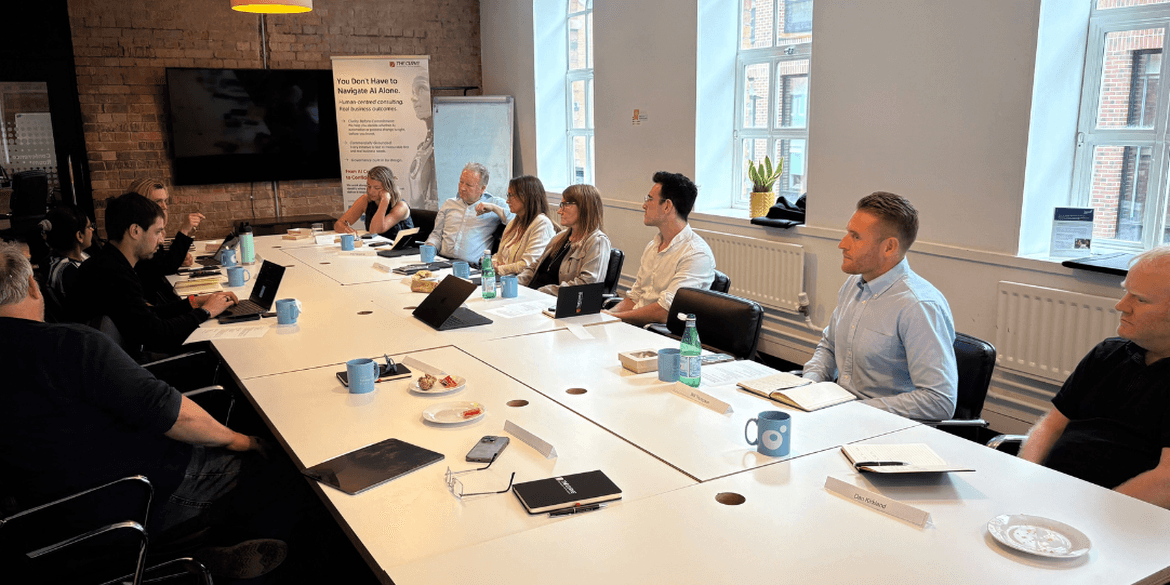
A few weeks ago, we brought senior leaders together across two roundtables, one in Sheffield, one in Leeds. No pitch decks. No vendor agenda. Just a candid conversation about what AI is genuinely doing inside their organisations, across law, financial services, professional and creative services, technology, retail, property, and the public and third sectors.
We wanted to know what was actually happening, not what people felt they should be saying about AI in public. The result is a report we've called The AI Reality Check, and the findings are more useful, and more honest, than most of what gets published on this topic.
The Question Has Already Changed
The clearest signal from both rooms was this. For these organisations, the question is no longer whether to use AI. It's how to do it well.
A law firm has spent two years running AI transcription and summarisation directly into its case management system, freeing lawyers to focus on the client conversation rather than the file note. A funeral services operator has moved photo quality control to AI across tens of thousands of services a year, removing manual checking while keeping a human eye on anything sensitive. A regulated national firm built a voice assistant trained on its own service desk knowledge to handle routine out-of-hours queries.
None of these were dramatic transformation projects. Each started with a single, specific, high-friction task. Each was proven before it was trusted. Only then was it extended. That pattern, prove it small before you scale it, came up again and again as the most reliable way into AI that actually works.
Scaling Is Harder Than Starting
If embedding a first use case is the easy part, scaling it is where most leaders told us they're genuinely stuck. Individuals across the business are getting real value. Turning that into a coordinated, governed, organisation-wide capability is a different and considerably harder problem.
A procurement specialist in the room described the waste this creates plainly. Licences bought and never used. Capable tools running on infrastructure too old to support them. Dozens of people running different tools, chasing the same outputs with no shared baseline.
Shadow AI came up repeatedly as a genuine concern. When people aren't given a good, approved tool, they don't wait. They find their own, often free consumer tools sitting outside any policy, and company data ends up pasted into systems the business can't see or control. The lesson from the room was direct: if you don't give people good tools, they will find their own.
Governance Has Become a Daily Discipline
Across both events, governance was treated not as a brake on progress but as the condition for it. One regulated firm has run a generative AI policy for more than two years, anchored in a small number of clear, memorable rules: never use a general-purpose assistant for legal research, always cross-check any citation against an authoritative source.
Data sovereignty drove concrete decisions too. Several organisations described keeping information within UK and EU boundaries as standard practice, securing agreements that their data wouldn't be used to train external models, and declining to switch on otherwise attractive tools where data processing fell outside acceptable limits.
Trust, the leaders agreed, is earned rather than assumed. One firm ran AI-generated summaries alongside human notes for months, checking one against the other, until confidence was high enough to rely on the tool without the parallel check.
One question stayed genuinely unresolved in both rooms: how do you train and supervise junior staff who can't yet tell when AI is wrong? As one leader put it, "you don't know what you don't know." Experienced professionals can usually spot a plausible falsehood. People early in their careers often can't. Nobody claimed to have solved it, and that honesty matters as much as any of the success stories.
The Human Element Keeps Resurfacing
For all the discussion of tools, the conversation kept returning to people. Leaders were genuinely wary of over-reliance eroding the knowledge their work depends on. Several said they'd rather do a task themselves and keep the understanding than spend as long prompting and checking a machine.
There was wariness too of AI models that behave like agreeable yes-men, reinforcing whatever they're told rather than offering real challenge. Resistance to AI adoption didn't sit where you might expect either. In one creative team, it was the younger staff pushing back on ethical grounds, while older colleagues embraced the tools. Elsewhere, it was senior technical staff who hesitated, out of understandable concern for their own roles.
A story about GP burnout captured something that resonated across the room. When the simple, restorative work is stripped away and only the hard cases remain, every interaction becomes relentless. The lesson carried straight across to professional services. The organisations thinking most clearly weren't spending their saved time on more volume. They were reinvesting it in the human relationships clients value most.
The Commercial Reckoning
Measurement is still immature almost everywhere. Most organisations are tracking time saved and output quality by hand, and several leaders were candid that they aren't yet measuring genuine outcomes. That pressure is coming fast as AI tool and usage costs climb.
One insight recurred, particularly from leaders with finance backgrounds. Efficiency only pays off if the time it frees gets converted into actual value, whether through higher fees or people moving to higher-value work. Otherwise, the organisation quietly absorbs the cost of its AI tools and erodes its own margin, an efficiency tax that's easy to miss.
The falling cost of building software is reshaping the build-versus-buy decision too. Several leaders talked about rebuilding costly niche subscriptions internally for a fraction of the price. The caution that came with it mattered just as much. Building a tool for internal use is one thing. Trying to commercialise something built quickly with AI assistance is a different and considerably riskier business, with real security and liability exposure attached.
What This Means for Your Organisation
Step back from the detail and a clear picture emerges. For established organisations, the question is no longer whether to use AI, but how to do it well. That's far easier to say than to do, which is why so many capable organisations stall somewhere between a promising pilot and embedded, accountable use.
The skills involved span strategy, data, security, change management, and commercial modelling. Rarely are all of those present in-house, and rarely are they available at the same time. One of the clearest stories from Leeds came from a leader who, unsure whether her own team's caution was justified, brought in an outside specialist to see through the noise and unlock progress that had been stuck for months.
That's the value an experienced partner brings. Not to take over, but to bring clarity, pace, and accountability to a journey that's genuinely hard to navigate alone.
The organisations that thrive over the next few years won't be the ones that adopted AI fastest. They'll be the ones that adopted it most deliberately, with the discipline to choose the right problems, the governance to do it safely, the humanity to keep their people and judgement at the centre, and the commercial clarity to know it's actually paying off.
Download The AI Reality Check: Executive Summary to read what these twenty leaders told us, in their own words.